Find A Buyer For An Inherited Property With Probate Issues
Topic: Find a Buyer for an Inherited Property With Probate Issues — how to sell without getting buried in delays, disputes, or paperwork
Find a Buyer for an Inherited Property With Probate Issues
Inheriting a property can feel like a blessing and a burden at the same time. On paper, it may be a valuable asset. In real life, it may come with unpaid bills, siblings who disagree, deferred maintenance, an old mortgage, title questions, or a probate court process that seems to move at its own pace.
The good news is that you can often find a buyer for an inherited property even when probate is involved. The key is matching the property with the right kind of buyer — and making sure the estate has the legal authority to sell before you get too far into the deal.
Probate rules vary by state, so this is one of those situations where a probate attorney, title company, and experienced real estate professional can save you from expensive mistakes. Nolo explains that an executor or personal representative may need court permission before selling real estate or distributing estate property, depending on the state, the will, and the type of probate being used. (Nolo)
First, what does “probate issues” actually mean?
Probate is the court-supervised process of validating a will, appointing someone to handle the estate, paying debts, and distributing remaining assets to heirs or beneficiaries. FindLaw describes probate as a process that can include validating the will, appointing an executor or administrator, inventorying assets, notifying creditors, paying debts, and distributing property. (FindLaw)
When a house is involved, probate issues may include:
The executor has not been officially appointed yet.
Multiple heirs disagree about selling.
The property has unpaid taxes, liens, or mortgage arrears.
The title is not ready to transfer.
The will is being challenged.
The property needs repairs or has code violations.
The estate needs court approval before closing.
The heirs live out of state and cannot manage the sale easily.
That does not automatically make the house unsellable. It just means the buyer must understand that probate sales can require extra steps and patience.
Can you sell an inherited house before probate is finished?
Sometimes, yes — but not always in the same way.
In many cases, the estate can market the property and accept an offer before probate is fully closed. But the sale may not be able to close until the personal representative has authority, court approval is obtained if required, and the title company is satisfied that the seller can legally transfer ownership.
Rocket Mortgage notes that probate sales can be complex and recommends working with a real estate agent who has probate-sale experience. (Rocket Mortgage)
The practical takeaway is simple:
You can often start looking for a buyer before probate is finished, but you usually need proper estate authority before the sale can close.
Best buyer types for inherited properties with probate issues
Not every buyer wants to deal with probate. A traditional buyer may love the house, but panic once they hear “court approval,” “multiple heirs,” or “estate sale.” That is why choosing the right buyer pool matters.
| Buyer type | Best for | Pros | Watch out for |
|---|---|---|---|
| Cash home buyer | Properties needing repairs, cleanout, or fast sale | Can buy as-is, often flexible on timing, fewer financing problems | Offer may be lower than market value |
| Local real estate investor | Houses with probate delays, title issues, or deferred maintenance | Used to complicated deals and distressed properties | Verify proof of funds and reputation |
| Probate real estate agent’s buyer network | Sellers who want market exposure but probate guidance | More competition may increase price | Sale may take longer than direct cash buyer |
| Contractor or flipper | Homes needing major renovation | Understands repair risk | Will price in repair costs and profit margin |
| Landlord buyer | Rentable inherited homes or occupied properties | May tolerate tenants and older condition | Still may require discounts for repairs |
| Traditional retail buyer | Homes in good condition with clear probate path | Often pays more | More likely to need financing, inspection, and a predictable closing date |
For many inherited properties, the strongest approach is to get one investor/cash offer, one local buyer offer, and one as-is listing estimate. That gives you a fair comparison between speed and price.
Step 1: Confirm who has authority to sell
Before chasing buyers, figure out who legally controls the property.
That person may be called the executor, administrator, or personal representative, depending on the state and whether there is a will. Until that person has legal authority, the heirs may not be able to sign a binding sale contract or transfer title.
Nolo notes that executors may need court permission before selling real estate, and that closing an estate often requires an accounting of how assets were handled. (Nolo)
Ask these questions early:
Has probate been opened?
Has the court appointed a personal representative?
Is there a will?
Does the will authorize sale of real estate?
Do all heirs agree to sell?
Is court approval required before closing?
Are there creditor claims, liens, or unpaid taxes?
Is the property titled only in the deceased owner’s name?
This step is not glamorous, but it can prevent a buyer from walking away later.
Step 2: Get the property valued as of the date of death
Inherited property has a tax issue that many heirs overlook: basis.
The IRS says that, to determine whether the sale of inherited property is taxable, you first need to determine the property’s basis. For inherited property, that basis is generally the fair market value on the date of the decedent’s death. (IRS)
That matters because if the home appreciated significantly during the original owner’s lifetime, the heirs may not owe capital gains tax on all of that old appreciation. The value usually resets for tax purposes at death, commonly called a step-up in basis. Fidelity describes this as an adjustment of the inherited asset’s cost basis to the fair market value on the date the owner died. (Fidelity)
A simple example:
| Item | Example amount |
|---|---|
| Parent bought the home years ago | $90,000 |
| Home value on date of death | $350,000 |
| Heirs later sell for | $365,000 |
| Potential taxable gain before selling costs | $15,000 |
This is not tax advice, and every estate is different. But getting a date-of-death valuation can help heirs avoid messy tax questions later.
Step 3: Decide whether to sell as-is or clean it up first
Inherited homes are often dated, full of belongings, or in poor condition. You may be tempted to renovate, but that is not always smart.
Repairs can create family disputes, delays, and upfront costs. One heir may want to remodel for top dollar. Another may want to sell immediately. Another may not have money to contribute.
A better first move is to compare three numbers:
| Option | What to estimate |
|---|---|
| Cash as-is sale | Fast offer minus any fees or closing costs |
| As-is MLS listing | Market price minus commissions, concessions, and time |
| Repair-then-sell | Renovated value minus repairs, holding costs, risk, and delays |
If the house needs major repairs, a cash buyer or investor may make more sense. If the property is mostly cosmetic and in a desirable area, listing as-is may bring a higher net price.
Step 4: Find buyers who understand probate
The best buyer for a probate property is not always the highest bidder. It is the buyer who can actually close under probate conditions.
Look for buyers who are comfortable with:
Delayed closing dates
Court approval timelines
Estate signatures
Title company requirements
As-is condition
Heir disputes
Cleanout after closing
Existing tenants
Mortgage payoff issues
Liens or unpaid taxes
A cash buyer may be especially useful if the property has a mortgage that must stay current. Rocket Mortgage notes that heirs may be able to continue making payments after inheriting a home, and federal law can limit enforcement of due-on-sale clauses after a borrower’s death in certain inheritance situations. (Rocket Mortgage)
That said, do not rely on a buyer’s verbal promises. The purchase contract should clearly explain what happens if probate approval takes longer than expected.
Step 5: Make the probate situation clear upfront
Do not hide the probate issue from buyers. It will show up during title work anyway.
A stronger listing or buyer conversation sounds like this:
“This is an inherited property being sold by the estate. Probate is currently in process. The estate is seeking an as-is buyer who understands that closing may depend on court authority and title clearance.”
That kind of honesty filters out impatient buyers and attracts the right ones.
Step 6: Compare offers by certainty, not just price
Probate sales can fall apart when buyers do not understand the process. A financed buyer might get nervous about delays. A first-time buyer may not understand estate signatures. An investor may offer cash but later try to renegotiate.
Use this table to compare offers:
| Offer factor | Why it matters |
|---|---|
| Proof of funds | Shows whether the buyer can actually close |
| Earnest money deposit | Shows seriousness |
| Inspection terms | Reduces risk of post-inspection price cuts |
| Closing flexibility | Important if court approval is needed |
| As-is language | Prevents repair disputes |
| Assignment clause | Tells you whether the buyer may wholesale the contract |
| Buyer experience | Probate buyers should understand delays and title work |
| Net proceeds | More important than headline price |
A slightly lower cash offer from a buyer who understands probate may be better than a higher offer that collapses two weeks before closing.
Interactive checklist: before accepting a buyer
Use this as a quick estate-sale readiness check:
| Question | Yes / No |
|---|---|
| Has the personal representative been appointed? | |
| Do you know whether court approval is required? | |
| Have all heirs been informed of the sale plan? | |
| Has the property been valued as of date of death? | |
| Are mortgage, tax, HOA, and utility balances known? | |
| Has a title company reviewed the ownership situation? | |
| Does the buyer have proof of funds or strong financing? | |
| Does the contract allow enough time for probate steps? | |
| Are sale proceeds going to the estate, not directly to heirs before approval? | |
| Has a probate attorney reviewed the plan if there are disputes? |
If several answers are “No,” the house may still be sellable — but you need to slow down enough to avoid a bad contract.
What if the heirs disagree?
This is one of the most common probate sale problems.
One sibling may want to keep the house. Another may want to sell. Another may believe the offer is too low. Someone may be living in the property. Someone else may be paying the bills.
When heirs disagree, communication matters. Put the numbers in writing:
Current as-is value
Repair estimates
Mortgage payoff
Tax liens or unpaid bills
Monthly carrying costs
Cash offer amount
Estimated net proceeds
Timeline to close
Risk of waiting
Sometimes the cleanest solution is selling the property and splitting proceeds according to the will or state law. Other times, one heir may buy out the others, possibly through refinancing. Rocket Mortgage notes that heirs who inherit with siblings may choose to share ownership, sell the property, buy out another heir’s share, or sell their own share. (Rocket Mortgage)
If the disagreement is serious, do not let a buyer become the referee. Bring in a probate attorney or mediator.
What if the inherited house has a mortgage?
A mortgage does not disappear when someone dies. The estate or heirs need to understand the loan balance, payment status, escrow, insurance, and whether foreclosure risk exists.
Rocket Mortgage explains that heirs may be able to keep making payments on an inherited home and, in some cases, assume the mortgage rather than triggering immediate payoff. (Rocket Mortgage)
For a sale, the mortgage is typically paid off at closing from the sale proceeds. But if the loan is already delinquent, speed becomes more important. A cash buyer who can close quickly after probate authority is confirmed may help prevent additional fees, foreclosure pressure, or property deterioration.
What if the property needs repairs?
This is where probate properties often become attractive to investors.
A traditional buyer may ask for repairs, credits, or a price reduction after inspection. A cash buyer may simply price the repairs into the offer and buy the property as-is.
That can be helpful if the inherited home has:
Old roof
Water damage
Outdated electrical
Foundation issues
Mold
Termite damage
Fire damage
Hoarding or cleanout needs
Code violations
Unpermitted work
Vacancy damage
The tradeoff is price. Investors need room for repairs, holding costs, resale expenses, and profit. So the offer will usually be lower than a fully renovated market price.
Sample message to send to a potential buyer
Here is a simple script:
“This is an inherited property currently going through probate. The estate is interested in an as-is sale. We are looking for a buyer who can provide proof of funds, allow reasonable time for probate/title requirements, and close through a reputable title company. The property will be sold in its current condition, and any offer should account for that.”
This immediately signals that you are serious, organized, and not looking for a messy negotiation.
Red flags when choosing a buyer
Be careful if a buyer:
Pressures heirs to sign before probate authority is clear
Refuses to provide proof of funds
Wants the deed transferred outside normal closing procedures
Asks heirs to take money “under the table”
Promises to “handle probate” without an attorney or court process
Keeps changing the price after inspection
Uses vague contract language
Discourages you from using your own title company or attorney
Claims all heirs do not need to be involved when they actually do
Probate already has enough moving parts. Do not add a risky buyer to the mix.
Suggested images for this blog post
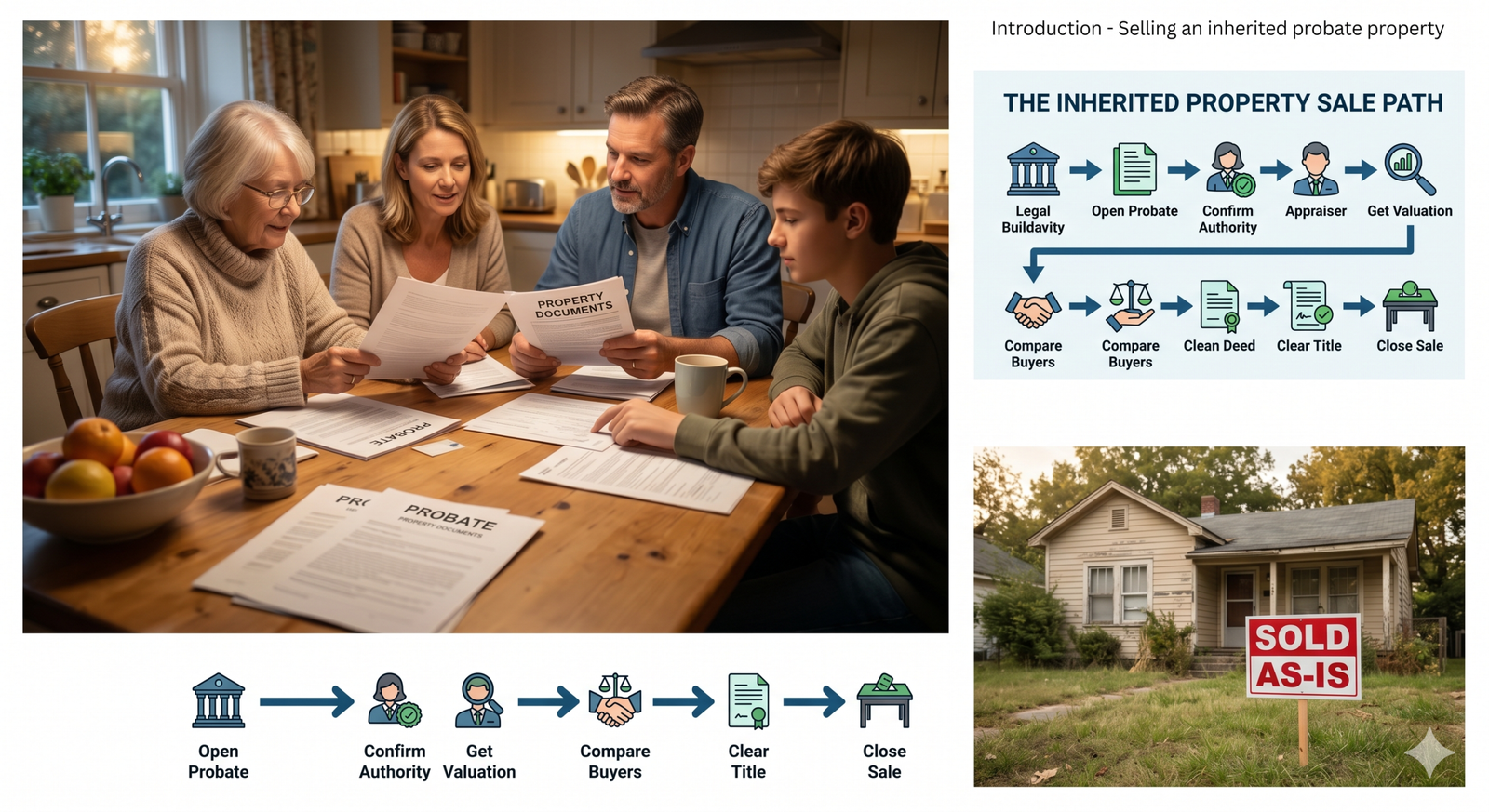
Use a warm, realistic image near the introduction: a family reviewing paperwork at a kitchen table. After the buyer comparison table, add a simple graphic showing the sale path: Open probate → Confirm authority → Get valuation → Compare buyers → Clear title → Close sale. Near the checklist, use an image of an older inherited home with a “sold as-is” sign to reinforce the topic visually.
Final takeaway
Finding a buyer for an inherited property with probate issues is absolutely possible, but it requires the right order of operations.
First, confirm who has legal authority. Then understand the property’s value, debts, condition, and tax basics. After that, look for buyers who are comfortable with probate timelines and as-is sales.
For many inherited homes, the best buyer is not simply the one offering the most money. It is the one who can close cleanly, respect the probate process, work with the title company, and give the estate a predictable path forward.
Probate can make a sale slower, but it does not have to make it impossible.